Archive

Daily Archives: November 11, 2012

Update on NaNoWriMo #11: Plot Cards

My original idea of Stepdad’s character was a bit of a caricature.

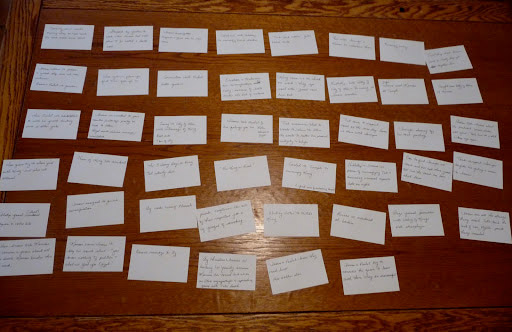
I’ve made two dozen plot cards and have been playing around with them. Already, I can see a problem.

I have several, mutually incompatible ideas for the first third of the book. Different variations on the set-up, with different roles for the supporting cast, in this case the stepfather and two guys tentatively named Laurde and Darke.

Originally, my hero Brandon was going to be living with his evil but stupid white trash Stepdad and dumb brutish stepbrothers, Laurde and Darke.

I wrote a couple seed scenes/set pieces with them, and things started going in a different direction. My original idea was rife with cliche, which I realized as soon as I tried to bring it to life. It’s one thing to retell a fairytale; that archetypal. It’s another to use hackneyed tropes; that’s stereotypical.

Real relationships are seldom all negative or all positive. It would be better to make Laurde and Darke  friends than stepbrothers…when they betray Brandon, it’s all the worse. His stepfather is a mean guy, but all the more reason to introduce him on a conciliatory note. The reader, like Brandon, can be skeptical but hopeful that the reconciliation will work, and the outcome won’t be telegraphed right from the start.

This idea in turn sparked all sorts of possible plot paths and scintillating scenes… which was fantastic… except that I realized most of this was all bulking up the first third of the novel. The middle, which should be longer, was instead, quite sparse. It’s not that I couldn’t fill it with plotlines once I get there, just the opposite. If I let myself go crazy with all the complications I wanted to introduce in Act I, Act II and III were going to have to be much longer than my outline calls for.

I need to keep working the cards around to see if some of these delightful wrinkles can be made to work in Act II….
NaNoWriMo Tip #11: What To Put On Plot Cards

Kimberly’s Wanderings has a great post on plot cards, with many helpful photos.

These are my personal tips for NaNoWriMo. You know the drill. Take only what works.

You may notice that other writers are pressing ahead with their manuscripts, whereas I’m still diddling around with my outline. There’s method to my madness, though, so I’ll continue to spend this week refining my outline. I’ll burn through several different kinds of outline before I’m done. Any one of these methods might alone suffice for you, but I use all of them. Every time. Seriously. It helps me figure out my plot inside and out, and each kind of outline helps me with a different stage of deepening the story.

For the purpose of these tips, I’ll present the kinds of outlines one per day, but in practice, I often work with two or three at the same time. It’s faster and I attack the story on multiple fronts.

I start with tried and true method of outlining, playing with plot cards. You take a nice deck of line or blank 3×5 index cards (or 5×7 if you prefer) and write down your plot points on them. Start with the scenes from your beat sheet, if you have nothing else, and then start filling in other cards with everything else you think you’ll need to include.

Then comes the fun part. Clear a table (in my house, this is an Issue) and spread your cards out in order. Shuffle them around. Combine them. Write new ones. Play with your plot. It’s all pretty fluid at this point. The plot cards allow you to honor that and experiment with shifting your scenes around into different orders.

If you have this idea that outlining is bad because it squashes your creativity, you’re not doing it right. There are lots of places for you to gush creativity all over the place. The brainstorming stage is a bonanza of creativity. In fact, if you just start writing whatever pops into your head without brainstorming first, you might end up writing a lot clichés. Clichés are like mosquitoes, ready to swarm you and bite. Good ideas are like nearly extinct reclusive Amazon jewel-skinned frogs that must be hunted down with great peril and sweat. Brainstorming allows you to push past the cloud of jungle mosquitoes until you reach the frogs.

Keep in mind that you’re still in the brainstorming phase all through the outlining phase. Playing with the plot cards also involves brainstorming and it definitely also involves juicing your imagination.
Some things that you should put on plot cards, the better to place perfectly in your story include:

– Introducing major characters (introduce each one in a separate scene, if possible) 
– The Inciting Incident
– Monster Attacks (or Various Bad Stuff That Happens, as suits your genre)
– Cliffhangers for each act
– Actions That Forward The Main Plot
– Actions That Forward The Subplot(s)
– Clues To The Mystery (including Red Herrings)
– Necessary Infodumps & Foreshadowing
– Juicy Scenes You Can’t Wait To Write (even if you haven’t figured out how to get there yet)
List these things on separate cards at first. As you move the cards around, look for opportunities to combine them. You especially will want to place potentially boring things, like Infodumps and Introducing New Characters, into exciting scenes that involve Monster Attacks.

Careful, though! Some things are better kept separate, for instance, introducing major characters and introducing subplots. That’s because it can get confusing if you try to wave too many flags in front of the reader at once. Once these are introduced, it’s easier to have more people on stage at the same time or to host events that further both the main plot (say, the mystery) and the subplot (say, the romance).